Blog

  • The New Leadership Trinity: How AI Strategy, Family Business Governance, and Executive Coaching Are Reshaping the C-Suite in the GCC

    The New Leadership Trinity: How AI Strategy, Family Business Governance, and Executive Coaching Are Reshaping the C-Suite in the GCC

    The business landscape in the Gulf Cooperation Council (GCC) is currently undergoing a structural transformation. By 2026, the traditional models of leadership that powered the region's growth are being replaced by a more sophisticated, three-pronged approach. We call this the Leadership Trinity: the intersection of AI Strategy, Family Business Governance, and Executive Coaching.

    For organizations in the UAE, Saudi Arabia, and Qatar, mastering these three domains is no longer a competitive advantage: it is a requirement for survival. As Vision 2030 accelerates and the next generation of leadership takes the helm of major family conglomerates, the C-suite must evolve to manage not just people and profits, but algorithms and legacies.


    Pillar 1: AI Strategy – From Digital Hype to Structural Force

    In 2026, Artificial Intelligence has moved beyond the "pilot project" phase. It is now a structural component of the GCC economy. Leaders who once viewed AI as a tool for IT departments are now recognizing it as a core driver of Organizational Strategy Training.

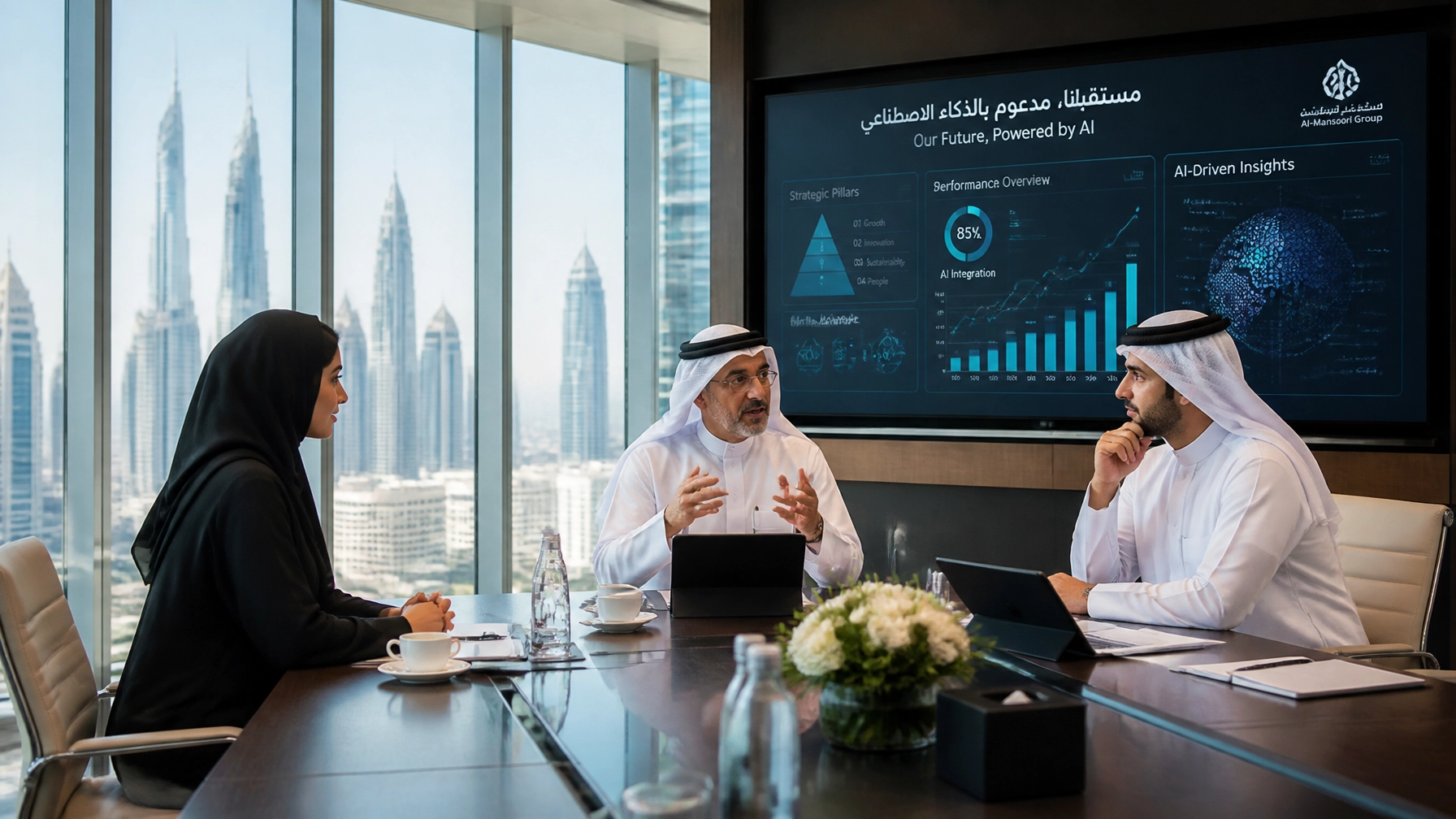
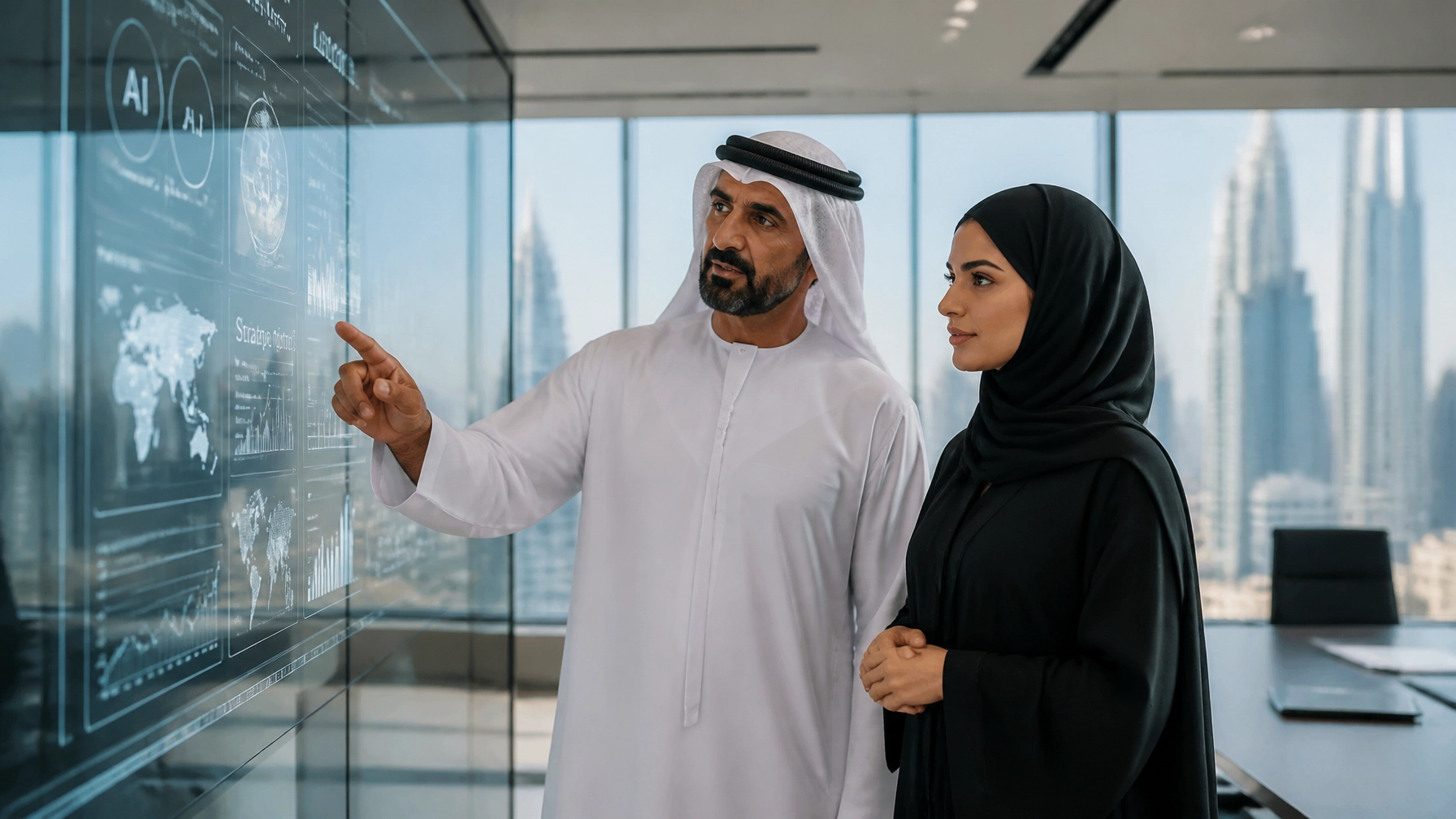
    An executive analyzing AI-driven data analytics on a modern dashboard in a Saudi Arabian corporate office

    The Shift to AI-Enabled Decision Making

    Today’s Digital Transformation Leadership requires moving from intuition-based choices to data-backed certainty. High-performing executives are now utilizing AI to:

    • Predictive Market Analysis: Anticipate shifts in regional energy prices or real estate demand before they happen.
    • Operational Efficiency: Automating back-office functions in large-scale holding companies to redirect human capital toward innovation.
    • Risk Mitigation: Identifying governance gaps through real-time data auditing.
    Practical AI Implementation for Leaders

    To successfully integrate AI, Exceed recommends a structured AI Strategy Workshop approach:

    1. Capability Audit: Evaluate the current digital literacy of your executive team.
    2. Use Case Prioritization: Select three high-impact areas (e.g., Supply Chain, Customer Experience, or HR Analytics) for immediate AI integration.
    3. Governance Layering: Ensure AI deployments align with regional regulations and ethical standards.

    Our Related Solutions:


    Pillar 2: Family Business Governance – The Infrastructure of Legacy

    Family businesses account for a significant portion of the GCC’s non-oil GDP. However, as these organizations move into their third and fourth generations, the "3rd Generation Curse" remains a threat. In 2026, Family Business Governance is the primary tool for institutionalizing trust and ensuring continuity.

    Two generations of family business leaders discussing governance and succession planning in a modern office

    The 4-Stage Succession Framework

    Effective Family Business Succession Planning is no longer an event; it is a multi-year process. Successful families are adopting a staged transition:

    • Assessment (Months 1–18): Objective evaluation of next-generation capability and appetite for leadership.
    • Structure (Months 12–24): Establishing Governance and Board Leadership Training and legal frameworks like DIFC or ADGM foundations.
    • Transition (Months 24–60): Staged transfer of equity and authority tied to performance milestones.
    • Continuity (Ongoing): Regular family councils to separate family emotion from business logic.
    Professionalizing the Board

    The modern Family Business Strategy GCC involves moving from honorary boards to working boards. This includes:

    • Appointing independent directors with specialized expertise in technology or global markets.
    • Establishing clear Strategic Decision Making Training for Executives to prevent family conflicts from stalling corporate growth.
    • Codifying a Family Constitution that outlines employment rules for the Next Generation Leadership Family Business.

    Our Related Solutions:


    Pillar 3: Executive Coaching – The Behavioral Bridge

    Strategy execution fails not because of bad plans, but because of human resistance. In the GCC’s high-stakes environment, Executive Coaching has become the behavioral glue that holds the Leadership Trinity together.

    A focused executive coaching session between two professionals in a bright, modern UAE office

    Why Coaching is Essential in 2026

    Traditional Leadership Training UAE often focuses on skills; coaching focuses on mindset. For the modern C-suite, coaching addresses:

    • Managing Change Fatigue: Helping leaders navigate the rapid pace of Digital Transformation Leadership.
    • Succession Anxiety: Supporting founders as they step back and next-gen leaders as they step up.
    • Strategic Foresight for Executives: Developing the mental agility to see beyond the immediate horizon.
    Core Coaching Outcomes for GCC Leaders
    • Communication Mastery: Essential for leaders presenting to sovereign wealth funds or international partners.
    • Emotional Intelligence (EQ): Crucial for maintaining harmony within multi-generational family businesses.
    • Strategy Execution Training: Moving from "vision" to "actionable results" through personal accountability.

    Our Related Solutions:


    Integrating the Trinity: Creating the Modern C-Suite

    The most successful organizations in the GCC are those that recognize these three pillars are interdependent. You cannot execute an AI Strategy without the Strategic Thinking Training for Leaders to understand its implications, nor can you sustain a Family Business without the Governance to manage it or the Coaching to lead it.

    Checklist for 2026 Leadership Readiness
    • Does your board include at least one member with deep AI/Technology expertise?
    • Is your succession plan documented, legally structured, and communicated to all stakeholders?
    • Are your high-potential leaders enrolled in Executive Leadership Programs GCC?
    • Do you have a formal Innovation Leadership Program to drive continuous improvement?
    • Is your Organizational Strategy Training updated to reflect the 2026 economic reality?
    Take Action: Challenge Your Leadership Model

    If your organization is still operating on a pre-2024 leadership model, you are falling behind. The transition to a modern, professionalized C-suite requires immediate investment in Leadership Capability Development.

    Program Category Primary Objective Target Audience
    Strategy & AI Value Creation & Tech Integration CEOs, CTOs, Strategy Heads
    Governance Stability & Succession Board Members, Family Principals
    Leadership Behavioral Change & Soft Skills Next-Gen Leaders, CXOs

    Secure Your Organization’s Future

    At Exceed, we specialize in designing Bespoke Corporate Training Solutions that reflect the unique cultural and strategic needs of GCC organizations. Whether you are looking for an AI for Executives Training or a comprehensive Leadership Development Program Saudi Arabia, our global network of faculty and university tie-ups ensures you receive world-class education tailored to your specific environment.

    CREATE YOUR OWN LEADERSHIP ROADMAP

    Fill out the form below to speak with one of our consultants about a customized executive education solution.

    Contact Our Experts

    SUBMIT


  • The $1 Trillion Transition: How AI Strategy and Executive Coaching Are Reshaping Family Business Succession in the GCC

    The $1 Trillion Transition: How AI Strategy and Executive Coaching Are Reshaping Family Business Succession in the GCC

    The Gulf Cooperation Council (GCC) stands at a historic crossroads. Recent market intelligence suggests that approximately $1 trillion in family business wealth will transition to the next generation by 2030. This monumental transfer is not merely a financial transaction; it is a fundamental shift in how the region's economic engines are governed, operated, and sustained.

    In an era defined by rapid technological disruption, the traditional models of family business succession planning are no longer sufficient. Today's "Next-Gen" leaders are inheriting enterprises that must contend with the dual pressures of maintaining legacy values and adopting AI leadership training to remain competitive. At Exceed, we recognize that navigating this transition requires a sophisticated blend of AI strategy, institutionalized family business governance GCC frameworks, and intensive executive coaching.

    The Scale of the Transition: Understanding the $1 Trillion Challenge

    Family-owned enterprises contribute significantly to the non-oil GDP of nations like Saudi Arabia and the UAE. However, the path to continuity is fraught with risk. Statistics indicate that roughly 80% of GCC family businesses are currently in critical transition stages.

    The Survival Statistics
    • Founder to 2nd Generation: Only ~30% of businesses successfully navigate this first handoff.
    • 2nd to 3rd Generation: Survival rates drop further to ~12%.
    • 4th Generation and Beyond: Only ~3% of family businesses persist, highlighting a massive "wealth leak" during transitions.
    Key Drivers of the Transition
    • Generational Gap: Differences in management style between traditional founders and tech-savvy successors.
    • Digital Immaturity: Legacy systems that cannot support modern digital transformation leadership.
    • Informal Governance: A lack of codified family business succession planning leads to ambiguity during crises.

    AI Strategy: The New Pillar of Family Governance

    For the modern GCC executive, AI is no longer a futuristic concept: it is a core component of organizational strategy training. Integrating AI for executives training into the succession process allows families to institutionalize knowledge and reduce "key-person risk" centered around the founder.

    A digital tablet showing a family business governance and AI risk assessment dashboard.

    Leveraging AI for Continuity
    • Risk Analytics: Using AI to map complex ownership structures and identify concentration risks across global portfolios.
    • Succession Readiness Dashboards: Real-time diagnostics that track the progress of leadership development programs for incoming family members.
    • Data-Driven Decision Making: Moving away from "gut-feeling" leadership toward structured, algorithmic insights that align with digital transformation leadership goals.
    Implementation Areas
    • Governance Mapping: AI-enabled tools to draft and simulate the impact of family constitutions.
    • Knowledge Transfer: Natural Language Processing (NLP) to document and categorize decades of founder experience into accessible training modules.
    • Strategy Execution: Utilizing AI to monitor strategy execution training outcomes across diverse business units.

    The Human Element: Why Executive Coaching is Non-Negotiable

    While technology provides the tools, people provide the direction. Executive coaching serves as the bridge between the technological potential of AI and the emotional complexity of family dynamics. In the GCC, where "Face" and reputation are paramount, coaching provides a neutral ground for honest dialogue.

    An executive coaching session in a bright, modern office overlooking a GCC cityscape.

    Coaching the Founder: The Art of Letting Go
    • Identity Shift: Helping founders transition from "Chief Decision Maker" to "Chairman/Mentor."
    • Legacy Definition: Clarifying how the founder's values can be preserved through corporate culture training.
    • Institutionalization: Encouraging the move from personalized power to structured governance.
    Developing Next Generation Leadership
    • Stakeholder Management: Successors must learn to manage not just employees, but siblings, cousins, and independent board members.
    • Governance Literacy: Building the skills necessary to lead within a family business governance GCC framework.
    • Confidence Building: Intensive leadership development Saudi Arabia and leadership training UAE programs help successors earn the respect of the existing workforce.
    Coaching for Conflict Resolution
    • Role Clarity: Distinguishing between ownership rights and management responsibilities.
    • Shared Vision: Aligning diverse family members behind a single organizational strategy training objective.

    Scaling Excellence: Leadership Development in Saudi Arabia and the UAE

    The regional landscape is rapidly evolving, driven by Vision 2030 in Saudi Arabia and the "We the UAE 2031" vision. These national agendas demand a new caliber of leader: one who is as comfortable with a P&L statement as they are with an AI roadmap.

    Tailored Learning Paths
    • Executive Training: Focus on AI leadership training to help C-suite executives oversee technical teams effectively.
    • Next-Gen Bootcamps: Immersive programs designed for next generation leadership family business cohorts to build camaraderie and shared skills.
    • Bespoke Solutions: At Exceed, we design programs that reflect the specific culture and challenges of each unique organization.
    Geographic Focus
    • Leadership Development Saudi Arabia: Addressing the massive scale of transformation in Giga-projects and diversified family conglomerates.
    • Leadership Training UAE: Focusing on global competitiveness, innovation, and sustainable digital transformation leadership.

    Strategy Execution and Corporate Culture

    A strategy is only as good as its execution. Many family businesses fail during succession because the "Strategy-Execution Gap" widens when leadership is in flux.

    A collaborative workshop setting where professionals focus on digital transformation and strategy execution.

    Strengthening the Execution Muscle
    • Accountability Frameworks: Implementing clear KPIs that apply to both family and non-family executives.
    • Cultural Alignment: Ensuring that corporate culture training bridges the gap between traditional values and a performance-driven mindset.
    • Agile Governance: Creating board structures that can pivot quickly in response to market changes or technological breakthroughs.
    Recommended Action Plan for GCC Family Offices
    1. Assessment: Conduct a formal "Succession Readiness Audit" combined with a digital maturity scan.
    2. Governance Codification: Finalize family charters and voting rules using family business governance GCC best practices.
    3. Skill Upgrading: Enroll both current and future leaders in AI for executives training and executive coaching.
    4. Institutionalize: Transition from "Founder-Led" to "System-Led" through comprehensive strategy execution training.

    Partnering with Exceed for Your Transition Journey

    The transition of $1 trillion is a high-stakes endeavor that requires more than generic training. It demands a partner who understands the intricacies of the GCC business environment and has a global network of expertise.

    At Exceed, we provide:

    • Customized Corporate Training: Solutions tailored to your specific organizational culture.
    • Extensive Faculty Network: Access to 100+ global faculty partnerships and 50+ university tie-ups.
    • Proven Track Record: Over 1500+ hours of high-impact program delivery experience.
    • Faster Time-to-Value: Our programs integrate seamlessly with your existing teams to drive immediate results.

    Are you ready to secure your family's legacy for the next century?

    SUBMIT AN INQUIRY TO EXCEED

    Select Your Strategic Priority:
    • Next-Gen Leadership Development
    • AI Strategy & Implementation
    • Family Business Governance & Succession
    • Executive Coaching for C-Suite

  • Are Traditional Leadership Programs Dead? Why AI-Powered Coaching is the New Standard

    Are Traditional Leadership Programs Dead? Why AI-Powered Coaching is the New Standard

    The landscape of corporate development is undergoing a seismic shift. For decades, the "gold standard" for leadership development involved fly-in workshops, generic three-day retreats, and static slide decks. However, by 2026, the data is clear: the traditional, one-size-fits-all approach is no longer sufficient to prepare executives for a volatile, AI-driven global economy.

    Organizations are now pivoting toward AI-Powered Coaching and Parallel Intelligence models. This isn't just a trend: it’s a response to the need for faster time-to-value, personalized learning, and measurable ROI.

    The Decline of the "One-Size-Fits-All" Workshop

    Traditional leadership programs often suffer from "shelf-ware" syndrome: high-quality content that is quickly forgotten because it lacks immediate application. Research indicates that traditional models often see completion rates as low as 64%, compared to the 89% observed in modern, tech-integrated formats.

    Key Limitations of Legacy Programs:
    • Static Content: Curriculum designed months in advance cannot adapt to real-time market shifts or organizational crises.
    • Lack of Scalability: Human-only Executive Coaching is traditionally reserved for the top 1% due to cost and logistical constraints.
    • Low Retention: Without ongoing nudges or "in-the-flow-of-work" support, 70% of new leadership skills are lost within 24 hours.
    • High Cost: Travel, venue, and facilitator fees often result in a prohibitively high cost-per-participant.

    A diverse group of executives in a collaborative strategy session using digital interfaces for real-time AI feedback.

    Why AI-Powered Coaching is the New Benchmark

    As we move through 2026, the transition to AI-augmented development has become the baseline. Companies like Exceed are leading this transformation by integrating bespoke strategies with cutting-edge Technology to deliver training that is both deeply personal and highly scalable.

    The AI Advantage:
    • On-Demand Availability: AI agents provide "always-on" micro-coaching, allowing leaders to get feedback on a difficult email or preparation for a board meeting at 2:00 AM.
    • Predictive Analytics: Using longitudinal data, AI can predict leadership "derailers" before they manifest, suggesting preventative modules or 1-on-1 human intervention.
    • 80% Cost Reduction: By automating routine skill-building and administrative tracking, organizations can democratize high-level coaching across all management tiers.
    • Hyper-Personalization: Content is dynamically adjusted based on the individual’s strengths, weaknesses, and the specific strategic goals of the firm.

    Comparing the Old vs. New Standard

    Feature Traditional Programs AI-Powered Coaching
    Accessibility Scheduled, fixed location 24/7, mobile-first, on-demand
    Personalization Cohort-based, generic Individualized, data-driven
    ROI Tracking Qualitative/Anecdotal Quantitative, behavior-based
    Scalability Limited by human hours Virtually unlimited
    Integration Separate from daily work Embedded in daily workflows

    The Hybrid Model: Parallel Intelligence for the C-Suite

    While AI excels at skill-building and goal tracking, the most complex leadership challenges: navigating organizational politics, identity work, and cultural transformation: still require the high-touch empathy of a human expert.

    At the senior level, the "Parallel Intelligence" model is the winner. This involves an AI system handling the data, summaries, and follow-ups, while an elite Executive Coach focuses on strategic judgment and high-stakes decision-making.

    How Parallel Intelligence Works:
    • Step 1: Assessment: AI tools analyze micro-expressions, voice sentiment, and 360-feedback to build a comprehensive profile.
    • Step 2: Micro-Coaching: The leader receives daily AI-driven prompts to reinforce specific behaviors (e.g., "active listening" during a morning scrum).
    • Step 3: Strategic Deep-Dive: The human coach uses the AI-generated data to facilitate high-impact monthly sessions that cut straight to the core of leadership challenges.
    • Step 4: Continuous Feedback: A closed-loop system where AI monitors progress and alerts the human coach to emerging needs.

    A minimalist workspace featuring an AI-driven executive coaching dashboard with performance metrics.

    Implementing Modern Leadership at Scale

    Transitioning from traditional programs to an AI-powered framework requires a deliberate Strategy. It is not about replacing your coaches, but about amplifying their impact and ensuring your leaders have the tools to survive a digital-first world.

    Action Steps for C-Suite Decision Makers:
    1. Audit Existing Programs: Identify which elements of your current training are "generic" and could be handled more efficiently by AI.
    2. Prioritize Bespoke Solutions: Generic AI tools provide generic results. Partner with organizations that build programs reflecting your unique Corporate Culture.
    3. Focus on Behavior Change: Move away from measuring "completion" and toward measuring "behavioral shift" using data-driven platforms.
    4. Select Your Technology: Choose a platform that integrates seamlessly with your existing communication tools (Slack, Teams, etc.).
    Challenges to Consider:
    • Data Privacy: Ensure all AI interactions are secure and compliant with local regulations (such as the EU AI Act or regional GCC data laws).
    • Adoption: Leaders must be "sold" on the value of AI as a partner, not a replacement.
    • Bias Mitigation: Regularly audit AI algorithms to ensure they are not perpetuating outdated leadership stereotypes.

    A confident executive woman leveraging modern technology for leadership development.

    Why Exceed is the Partner of Choice for 2026

    At Exceed, we don't just deliver training; we design learning experiences that align with your organizational DNA. With a global network of over 100+ faculty partnerships and a proven track record of 1500+ hours in program delivery, we bridge the gap between traditional wisdom and future-ready technology.

    Our Capabilities Include:
    Take the Next Step:

    Are you ready to move beyond the limitations of traditional programs? Challenge your team to embrace the new standard.

    CREATE YOUR OWN MODERN LEADERSHIP ROADMAP

    • Option 1: Schedule a discovery call with our Strategy Experts.
    • Option 2: Download our whitepaper on "AI in the Boardroom".
    • Option 3: Pilot an AI-Powered Coaching program for your high-potential leaders.

    SUBMIT your inquiry today to begin your transformation.


  • The Proven Executive Coaching Framework for Scaling Family Businesses in the AI Era

    The Proven Executive Coaching Framework for Scaling Family Businesses in the AI Era

    For family-owned enterprises, the transition from traditional business models to AI-driven operations is more than a technical upgrade: it is a leadership evolution. Scaling a family business in the AI era requires a delicate balance: preserving the core values and legacy of the founders while embracing the exponential potential of agentic AI and data-driven decision-making.

    At Exceed, we recognize that the primary barrier to scaling isn't the technology itself, but the readiness of the leadership to manage it. This guide outlines a high-impact, 12-month Executive Coaching framework designed specifically for C-suite executives and family principals looking to institutionalize governance and de-risk succession through digital transformation.


    The Four Pillars of AI-Native Leadership

    Scaling in the modern era requires a shift from incremental growth to exponential thinking. Our framework is built on four critical pillars that ensure your leadership team is equipped for the future.

    1. Cognitive Readiness & Exponential Mindset
    • Exponential Thinking: Moving leaders beyond 5% annual growth targets to 10x opportunities enabled by AI leverage.
    • AI Literacy: Building a functional understanding of agentic AI, data economics, and risk management.
    • Communication Mastery: Coaching leaders to handle difficult conversations regarding automation and workforce shifts.
    2. Digital Fluency & Data Governance
    • Data as an Asset: Transitioning from "IT-managed data" to "Family-owned data assets."
    • Strategic Use-Cases: Coaching executives to prioritize AI applications that drive the highest ROI.
    • Ethical AI: Establishing clear guardrails for how AI interacts with your brand and customers.
    3. Family Governance & Succession
    • Institutionalization: Formalizing Family Councils and Boards to oversee AI investments.
    • Succession De-risking: Integrating AI milestones into the development plans for next-gen leaders.
    • Governance Digital Twins: Codifying family rules and values into digital systems to ensure continuity across generations.
    4. Next-Gen Scaling Readiness
    • AI-Native Operating Models: Preparing heirs to manage organizations where AI agents handle routine operations.
    • Reverse Mentorship: Creating structures where younger, tech-fluent family members teach elders about AI tools while receiving coaching on strategy and risk.

    The 12-Month Proven Coaching Framework

    We deliver results through a phased approach that integrates Executive Coaching with Technology Strategy.

    Senior executive and next-gen leader reviewing AI data insights on a tablet

    Phase 1: Assessment & Strategic Alignment (Months 1–3)

    The foundation of scaling is ensuring all principals are moving in the same direction. We conduct a deep dive into your current state.

    • Leadership Audit: We assess the digital mindset and AI readiness of your C-suite and family principals.
    • Governance Review: Mapping existing Family Council roles and identifying power centers that may impact transformation.
    • AI Strategy Mapping: Aligning tech initiatives with your 5-year Family Business vision.

    Phase 1 Outputs:

    • A unified AI vision statement for the family.
    • A prioritized portfolio of AI use cases ranked by effort and impact.
    • A risk-mitigation roadmap for initial pilot programs.

    Phase 2: Foundation & Pilot Implementation (Months 4–8)

    During this phase, we move from theory to practice, embedding AI capabilities into your daily leadership rhythm.

    • Executive 1:1 Coaching: Focused sessions on change management and role-modeling AI adoption.
    • AI Academies: Specialized workshops for family members to build foundational technical fluency.
    • Pilot Launch: Deploying high-value AI agents in specific departments: such as internal analytics or customer support: to demonstrate tangible value.

    Executive coach presenting a 3-phase strategic roadmap in a modern office

    Phase 2 Outputs:

    • A formalized Data Governance Framework endorsed by the Family Board.
    • Live AI pilots that act as learning vehicles for Leadership Development.

    Phase 3: Scaling & Succession Integration (Months 9–12)

    The final phase focuses on long-term sustainability and ensuring the business is ready for the next generation of Future Leaders.

    • Succession Integration: Making AI leadership a core requirement for next-gen transition plans.
    • Governance Ownership: Clarifying which AI-driven decisions are made by the Board versus the Management team.
    • Value Realization: Coaching leaders to measure success in "time returned" and strategic bandwidth, not just cost savings.

    Phase 3 Outputs:

    • A finalized Digital Twin of your family governance rules.
    • A succession plan with explicit AI-native responsibilities.
    • A quarterly rhythm for continuous leadership evolution.

    Specialized Governance for the GCC Market

    In the GCC, family businesses face unique pressures from rapid national digitalization and shifting regulatory landscapes. Our framework addresses these by:

    • Family-Centric AI: We move AI strategy from the IT basement to the Family Council table.
    • Legacy Preservation: Using AI to codify and protect the values that have defined your family for decades.
    • Proactive Succession: Moving away from crisis-driven transitions by preparing heirs years in advance through structured Strategic Planning.

    A digital hologram of a family legacy tree representing governance evolution


    Technical Specifications: Coaching Options

    To ensure a personalized experience, we offer several configurations for our coaching engagements:

    Feature Core Executive Principal/Founder Next-Gen Heirs
    Session Frequency Bi-weekly Weekly Bi-weekly
    AI Assessment Professional Strategic Operational
    Governance Role Management Board Oversight Implementation
    Technical Focus Efficiency/ROI Risk/Legacy Innovation/Scale
    Duration 9 Months 12 Months 12 Months

    Elevate Your Family Business Today

    Scaling in the AI era is a challenge that requires expert guidance and a proven roadmap. Our team at Exceed works directly with you to create personalized learning experiences that align with your specific organizational culture.

    Are you ready to future-proof your legacy?

    • Challenge your colleague: Share this framework with your Board and ask: "Are we scaling or just surviving?"
    • Create your own: Define your top 3 AI use cases for the next 12 months.
    • Connect with us: Speak to one of our Future Experts like John Sanei or Andrew Bryant to customize this framework for your organization.

    SUBMIT AN INQUIRY

  • How to Integrate AI Strategy With Your Family Business Governance

    For multi-generational family businesses in the GCC and beyond, the rise of Artificial Intelligence (AI) represents more than just a technological shift: it is a governance challenge. Unlike traditional IT projects, AI strategy touches the very core of family legacy: data privacy, decision-making authority, and the preservation of values across generations.

    At Exceed, we recognize that for family enterprises, digital transformation must be anchored in a robust governance framework. Integrating AI into your business isn't about chasing the latest trend; it is about reinforcing your family’s stewardship for the next century.

    The Intersection of Tradition and Technology

    Family governance structures, such as family councils and boards, were originally designed for environments with slower decision cycles. AI fundamentally accelerates these cycles, requiring a shift from reactive oversight to proactive Digital Stewardship.

    Why Governance Comes First
    • Legacy Protection: AI models can unintentionally misinterpret or expose sensitive family data if not governed.
    • Trust and Harmony: Automated decisions in areas like hiring or investment can create friction if the logic is not transparent to all family members.
    • Decision Rights: Clarifying who owns the "AI button": the board, the CEO, or the family council: is essential to prevent conflict.

    Building the AI Governance Framework

    Integrating AI requires specific instruments that go beyond your existing Articles of Association. A successful integration strategy utilizes a specialized framework designed to mitigate risk while maximizing ROI.

    1. The AI Governance Charter

    The family board should ratify a formal document that defines:

    • Purpose: Why are we adopting AI? (e.g., operational efficiency, wealth preservation, or market expansion).
    • Ethical Guardrails: Alignment with family values, such as integrity and Sharia compliance where applicable.
    • Accountability: Establishing who is responsible when an AI-driven prediction results in a strategic error.
    2. The AI Steward

    Appointing an AI Steward: often a Next-Gen leader or a specialized member of the family office: ensures there is a central point of contact for monitoring AI adoption and risks.

    A professional portrait of a young Next-Gen executive in a modern office setting, looking at a digital tablet showing data analytics. The lighting is crisp and natural, emphasizing a fresh and uplifting professional look. The background is a clean, minimal office space.

    Aligning AI Strategy With Family Values

    A common mistake is treating AI as a "buy-and-forget" software solution. For family businesses, every AI initiative must be mapped against the long-term vision of the organization.

    The Build vs. Buy vs. Partner Logic

    When selecting AI solutions, the board should follow a structured decision-making process:

    • Build: Use internal resources when the AI touches unique family IP or a core competitive advantage.
    • Buy: Opt for off-the-shelf solutions for commoditized tasks like standard back-office analytics or generic customer service bots.
    • Partner: Engage with expert firms like Exceed when navigating complex integrations that require Bespoke Corporate Training and cultural alignment.
    Strategic Mapping

    Create an AI Strategic Map to link every project to a business goal:

    1. Efficiency: Automating financial reporting or supply chain demand forecasting.
    2. Experience: Using AI to personalize client interactions in the family's retail or real estate arms.
    3. Governance: Using sentiment analysis to gauge employee morale or family member alignment.

    A 3-Phase Roadmap for GCC Family Businesses

    At Exceed, our experience in delivering over 1500+ hours of executive education has shown that a phased approach is the most effective way to manage change in traditional environments.

    Phase 1: Preparation (Months 0–6)

    • Assessment: Conduct a digital maturity audit of your current governance and data structures.
    • Education: Enroll the board and C-suite in Executive Coaching focused on AI literacy and ethical oversight.
    • Charter: Draft and ratify your AI Governance Charter.

    Phase 2: Pilot and Learn (Months 6–12)

    • Launch Pilots: Start with low-risk, high-learning projects, such as internal knowledge assistants for family history or financial dashboards.
    • Feedback Loops: Use 90-day review cycles to present pilot results to the Family Council.
    • Refine: Adjust the governance rules based on real-world pilot performance.

    Phase 3: Scale and Institutionalize (Months 12–18)

    • Integration: Embed AI-driven insights into standard monthly board packs.
    • Succession: Include digital leadership metrics in your Succession Planning to ensure Next-Gen leaders are "AI-ready."
    • Expansion: Scale successful AI tools across all international holdings and regional GCC operations.

    A clean, graphic illustration of a 3-phase strategic roadmap for business growth. The style is modern and professional, using a bright and fresh color palette with minimal icons representing Preparation, Pilot, and Scale. The layout is easy to scan.

    Upskilling the Board: The Role of Executive Coaching

    The most significant barrier to AI integration isn't technology: it's Brain Capital. This refers to the judgment, resilience, and alignment of the people leading the business.

    Exceed specializes in helping organizations bridge this gap. Through our extensive network of 100+ faculty partnerships and 50+ university tie-ups, we design Customized Learning Experiences that translate complex AI concepts into actionable governance strategies for C-suite executives.

    Key Training Areas for Boards:
    • AI Literacy: Understanding what AI can and cannot do for the business.
    • Algorithmic Bias: Learning how to identify and mitigate risks in automated decision-making.
    • Digital Transformation: Leading the cultural shift required to embrace data-driven insights.

    Strategic Checklist for the Family Board

    To begin your integration journey, use the following checklist to evaluate your current standing:

    Checklist Item Description Status
    Governance Audit Mapping current AI touchpoints and data risks. [ ]
    Appoint Steward Defining the lead role for AI oversight. [ ]
    Draft Charter Formalizing the AI Governance document. [ ]
    Board Education Completing Executive Coaching for AI literacy. [ ]
    Select Pilots Identifying 2-3 high-impact, low-risk test cases. [ ]

    Conclusion: Securing the Future

    Integrating AI with family business governance is not merely a technical upgrade; it is a strategic imperative to ensure the longevity of your family’s legacy. By establishing a clear charter, appointing the right stewards, and investing in continuous executive education, GCC family businesses can turn AI from a disruptive threat into a powerful tool for stewardship.

    Are you ready to align your organization’s strategy with the future of AI?

    SUBMIT A REQUEST FOR A CUSTOMIZED TRAINING PROPOSAL

    A close-up, high-quality photograph of two professionals shaking hands in a bright, modern office with large windows. The sun is shining through, creating a warm, natural, and positive atmosphere. The focus is crisp on the handshake, symbolizing a successful partnership.

  • How to Integrate AI Strategy With Family Business Succession Planning

    How to Integrate AI Strategy With Family Business Succession Planning

    For many family-owned enterprises in the GCC, the transition of leadership from the founding generation to the next is the most critical period in the firm's history. In 2026, this transition is no longer just about legal frameworks or ownership shares: it is about Digital Transformation.

    Integrating AI Strategy into your succession plan ensures that the next generation of leaders inherits a business that is not only stable but also future-proof. At Exceed, we believe that AI is the bridge that connects legacy values with modern operational excellence.


    The New Succession Landscape: Why AI Matters Now

    Succession planning in the modern era is a governance challenge that requires a technical lens. As regional economies shift toward the goals of Vision 2030 and other national initiatives, the traditional "wait-and-see" approach to technology is becoming a liability.

    Bridging the Information Gap
    • Founder Wisdom vs. Heirs' Tech-Savviness: Often, founders hold the "gut feeling" for the business, while heirs bring digital fluency. AI serves as a translator, turning historical intuition into data-backed models that both generations can trust.
    • Transparency: AI platforms provide a "single source of truth" for family wealth and business performance, reducing friction during the handover.
    • Professionalization: Implementing an AI strategy forces a business to professionalize its data and reporting structures, making it easier for a successor to take the reins.

    A professional family council meeting discussing modern governance.


    Embedding AI into Family Governance

    For AI to be effective, it cannot exist as a siloed IT project. It must be embedded into the very fabric of your Family Governance. This ensures that the technology aligns with the family’s long-term vision and core values.

    Update Your Family Charter

    When drafting or revising your Family Constitution, consider including specific digital and data principles:

    • Data Stewardship: Define who owns family data and how it should be used to protect the family’s reputation.
    • Innovation Mandates: Formally give the next generation the authority to lead AI pilots and digital transformation initiatives.
    • Conflict Resolution: Establish rules for resolving disagreements between the "traditionalist" and "innovator" factions of the family.
    Establish a Technology Committee

    Move beyond the traditional board structure. A specialized committee should:

    • Oversee AI Ethics and risk management.
    • Monitor the ROI of digital investments.
    • Report directly to the Family Council to ensure strategic alignment.

    LEARN MORE ABOUT FAMILY GOVERNANCE
    Explore our Family Business Capabilities


    AI as a Tool for Succession Transparency

    One of the greatest risks during a leadership transition is information asymmetry. AI tools can mitigate this by automating the consolidation of complex business data into actionable insights.

    AI-driven data visualizations for family office and business strategy.

    Strategic Use Cases for Successors
    1. Scenario Modeling: Use AI to simulate market shocks or leadership changes and their impact on the family's portfolio.
    2. Succession Analytics: Objective assessment tools can help identify the strengths and development areas of next-gen family members.
    3. Automated Reporting: Modern platforms use AI to ingest unstructured data (like legal documents and fund reports), providing a clear picture of total wealth.

    COURSES-

    • Strategic AI Implementation
    • Next-Gen Leadership Development
    • Data-Driven Governance

    View Technology Programs


    A Practical 4-Phase Roadmap for Integration

    Integrating AI into your succession plan is a marathon, not a sprint. Follow this structured approach to ensure a smooth transition:

    Phase 1: Diagnose and Align
    • Map current leadership roles and identify high-impact AI use cases.
    • Conduct a "values workshop" to ensure AI goals match family identity.
    Phase 2: Design Governance
    • Update your Family Charter with digital mandates.
    • Establish an AI Oversight Committee on the board.
    Phase 3: Pilot for "Earned Succession"
    • Launch small-scale AI projects (e.g., customer service bots or internal analytics).
    • Assign next-gen family members as Project Owners to help them build credibility within the organization.
    Phase 4: Institutionalize
    • Scale successful pilots across the group.
    • Integrate AI performance metrics into executive KPIs.

    The Role of Executive Coaching and Training

    Technology is only half the battle. The human element: Modern Leadership: is what determines the success of a succession plan. This is where Executive Coaching becomes indispensable.

    An executive education workshop at Exceed focusing on leadership.

    At Exceed, we design bespoke training solutions that prepare leaders for the complexities of the AI era. Our programs help successors develop the "Brain Capital" needed to balance technological innovation with the emotional intelligence required to lead a family firm.

    Our Approach Includes:
    • Bespoke Corporate Training: Tailored to your specific organizational culture.
    • Global Faculty Partnerships: Access to 100+ experts and 50+ university tie-ups.
    • Practical Application: Over 1500+ hours of proven program delivery experience.

    CHALLENGE YOUR COLLEAGUE
    Does your current leadership have a defined AI strategy for the next five years? If not, the time to start is now.

    CONTACT US
    Get a customized training proposal


    Conclusion: Securing Your Legacy

    The integration of AI strategy into family business succession planning is more than a modernization effort: it is an act of stewardship. By leveraging technology to create transparency, professionalize governance, and empower the next generation, you are ensuring that your family’s legacy remains vibrant and relevant for decades to come.

    Next Steps for Leaders:
    1. Assessment: Evaluate your current digital maturity.
    2. Strategy: Align your tech roadmap with your succession timeline.
    3. Education: Enroll your leadership team in a Strategy and Future-Focus Program.

    SUBMIT your inquiry today to start building your future-ready succession plan.


  • How to Integrate AI Strategy with Executive Coaching for GCC Family Businesses

    The GCC landscape is undergoing a monumental shift. As the region moves from oil-dependent economies to knowledge-based powerhouses, family-owned conglomerates, the backbone of the private sector, face a dual challenge: the rapid onset of Artificial Intelligence (AI) and the critical transition of multi-generational succession planning.

    By 2026, AI is no longer a "tech project"; it is a governance requirement. Integrating AI strategy with executive coaching is not just about efficiency, it is about ensuring your family legacy remains relevant in an autonomous future.

    At Exceed, we specialize in bridging the gap between legacy values and future-ready capabilities through bespoke executive education and strategy integration.


    The Strategic Intersection: Why Coaching and AI Must Align

    In many GCC organizations, a significant "value gap" exists. While 73% of regional C-suite leaders have piloted generative AI, only a fraction have realized measurable ROI. The bottleneck is rarely the technology itself; it is the human infrastructure.

    Integrating Executive Coaching into your AI roadmap ensures that leadership behavior evolves alongside the tech stack.

    Key Pillars of Integration:
    • Cognitive Readiness: Training the executive brain to move from "incremental growth" to "exponential thinking."
    • Digital Fluency: Moving beyond buzzwords to understand the economics of Agentic AI and data governance.
    • Cultural Safety: Addressing the psychological impact of automation on long-tenured employees and family members.
    • Governance Ownership: Shifting AI from the IT department to the Family Council and Boardroom.

    1. AI Strategy as a Governance Asset

    Close-up of a professional woman in business attire looking at a tablet in a bright modern office with city skyline, high focus, uplifting atmosphere

    For GCC family businesses, proprietary data and "the way we do things" are competitive advantages. In 2026, these must be codified into governed AI models.

    From Operational Alpha to Strategic Moats

    Leading family offices are now using AI to create "Operational Alpha", structural cost efficiencies that fund future growth. This requires a Strategy that views AI as a strategic asset rather than an expense.

    Strategic Checkpoints for the Board:
    • Data Sovereignty: Does the family retain ownership and control over the data fed into LLMs?
    • Model Governance: Are the algorithms encoding family values and risk appetites correctly?
    • Value Pools: Have you identified the 3–5 core business areas where AI will deliver 10x impact?
    • Decision Logic: How much of the current Principal's tacit knowledge can be digitized to assist future generations?

    2. Executive Coaching for Digital-Era Leadership

    Digital transformation is inherently a leadership challenge. Research shows that coaching senior leaders can increase the likelihood of transformation success by over 70%.

    For a GCC leader, the role is shifting from "Commander" to "Enterprise Multiplier." This requires a specific type of Leadership development that emphasizes high emotional intelligence (EQ) and tech-savvy judgment.

    Focus Areas for Executive Coaching:
    • The AI-Literate Principal: Helping the current generation understand AI’s impact on the family legacy without needing to code.
    • Change Resilience: Managing the "middle-management freeze" where fear of AI-driven job loss halts progress.
    • Decision-Making Complexity: Using AI for data-backed insights while retaining the final "human-in-the-loop" judgment for reputational risks.
    • Influence Without Authority: Coaching leaders to work across global capability centers and diverse ecosystems.

    Our experts, such as Andrew Bryant and John Sanei, focus on this exact transition, preparing the human mind for the future of work.


    3. Bridging the Generational Gap: Succession in the AI Era

    Elder Arab businessman and a younger female executive collaborating over a laptop in a professional high-end office, warm lighting, focus on mentorship

    Succession planning in the GCC has traditionally focused on legal structures and title transfers. In the high-AI context of 2026, Family Business succession must include Digital Heritage.

    The Next-Gen Mandate

    Next-generation leaders are often more tech-fluent but may lack the deep industry intuition of the founders. AI serves as the bridge.

    Integrating AI into Succession:
    1. Knowledge Transfer: Capture the tacit knowledge of the founder into proprietary AI "playbooks" or agents.
    2. Next-Gen Readiness: Coach heirs not just to manage assets, but to orchestrate AI-native operating models.
    3. Role Redefinition: As routine tasks are automated, the successor’s role tilts toward relationship management and ecosystem growth.
    4. Reverse Mentorship: Create a formal structure where younger members coach elders on AI tools, while elders coach on strategic nuance.

    Expert Martin Roll emphasizes that family business success depends on this balance of "tradition and transformation."


    4. Implementation Framework: The 2026 Roadmap

    Integrating these elements requires a structured approach. Use the following framework to align your leadership and technology goals.

    Phase 1: Assessment & Alignment (Months 1-3)
    • Leadership Audit: Evaluate the digital mindset and AI literacy of the C-suite.
    • Strategy Mapping: Align AI initiatives with the 5-year family business vision.
    • Executive Coaching Kickoff: Match principals with coaches who have tech-transformation experience.
    Phase 2: Foundation & Pilot (Months 4-8)
    • Data Governance: Establish rules for data quality and ethical AI use.
    • Capability Building: Launch internal academies or Future-focused workshops.
    • Agentic AI Pilots: Deploy AI agents in low-risk/high-value areas like internal analytics or customer support.
    Phase 3: Scaling & Governance (Months 9-12)
    • Succession Integration: Formally include AI milestones in the leadership transition plan.
    • Value Realization: Measure ROI not just in cost saved, but in "time returned" to leaders for strategic thinking.
    • Legacy Preservation: Finalize the "Digital Twin" of family governance rules.

    Interactive Leadership Assessment

    Evaluate your current readiness for the AI-Coaching integration.

    1. Has your Board/Family Council formally discussed AI strategy in the last 6 months?

    • ( ) Yes
    • ( ) No

    2. What is the primary focus of your current executive coaching programs?

    • [Dropdown: Operational Excellence / Leadership Behavior / Digital Transformation / Conflict Resolution]

    3. Do you have a documented plan for how AI will impact your 10-year succession goal?

    • ( ) Fully Documented
    • ( ) In Progress
    • ( ) Not Started

    SUBMIT


    The Exceed Advantage

    Abstract representation of data flow and human networks, clean white background, minimalist and professional aesthetic

    Integrating AI with Executive Coaching is a bespoke process. There is no one-size-fits-all solution for GCC conglomerates that manage billions in assets across multiple sectors.

    At Exceed, we provide:

    • Customized Solutions: Programs tailored to your specific organizational strategy and corporate culture.
    • Global Expert Network: Access to 100+ faculty partnerships and 50+ university tie-ups worldwide.
    • Proven Experience: Over 1500+ hours of program delivery experience in the region.
    • Shared Vision: We embed your goals directly into our training to ensure faster time-to-value.

    Challenge Your Strategy

    Are you leading an AI-enabled organization, or just a traditional business with a few new tools? The difference lies in your leadership’s ability to evolve.

    Ready to transform your leadership for the AI era?
    Contact Exceed Today to design your bespoke executive education roadmap.

  • How to Integrate AI Strategy With Family Business Governance for 2026 Growth

    As we approach 2026, the landscape for family-owned enterprises: particularly within the GCC: is undergoing a radical shift. The convergence of intergenerational succession and the rapid acceleration of Artificial Intelligence (AI) presents both a significant risk and an unprecedented growth opportunity. For many organizations, the traditional models of Family Business Governance are no longer sufficient to manage the complexities of a digital-first economy.

    Integrating a robust AI Strategy into the heart of family governance is no longer a "tech project"; it is a foundational requirement for long-term survival and competitiveness. At Exceed, we specialize in bridging the gap between legacy values and future-ready technology through bespoke Strategy Development and executive education.

    This guide outlines the critical steps for family businesses to modernize their governance frameworks, professionalize their leadership through Executive Coaching, and leverage AI to drive 2026 growth.

    1. Establishing the AI Governance Charter

    Governance in a family business context often revolves around preserving harmony and the founder's legacy. However, AI introduces new variables: data privacy, algorithmic bias, and the speed of decision-making. To navigate this, boards must move beyond generic digital transformation and establish a formal AI Governance Charter.

    Key Components of an AI Charter:
    • Definition of Scope: Explicitly state where AI will be utilized: such as portfolio management, market analytics, or operational automation: and where human oversight is non-negotiable (e.g., family succession and sensitive HR decisions).
    • Ethical Framework: Align AI deployment with core family values. If your family business prides itself on community impact, your AI strategy should prioritize transparency and fairness in its output.
    • Risk Mitigation Protocols: Establish clear guidelines for data residency (critical for GCC entities), cybersecurity, and vendor due diligence.
    • The "Human-in-the-Loop" Mandate: Ensure that AI serves as a decision-support layer. For instance, any AI-generated investment recommendation must be reviewed by at least two senior board members.

    A professional workshop setting where family members of different generations: a senior patriarch and a younger female executive: are collaborating over a digital tablet. They are working on a document titled

    2. Professionalizing the Board with Executive Education

    The gap between executive vision and technological reality is often wide. To lead an AI-integrated organization, the board itself must undergo a transformation. This requires more than a standard seminar; it necessitates high-impact Executive Education tailored to the specific needs of family leaders.

    Board-Level Competencies for 2026:
    • Digital Literacy for Directors: Understanding the difference between Generative AI, Machine Learning, and Predictive Analytics.
    • Strategic Oversight: Shifting from "managing operations" to "governing systems." Leaders must learn to interpret AI-driven board packs and challenge data-driven assumptions.
    • AI for Decision Support: Utilizing real-time, "total wealth" dashboards that aggregate data from operating companies, real estate, and global financial assets into a single view.

    At Exceed, we leverage a global network of over 100+ faculty partnerships and 50+ university tie-ups to bring world-class expertise: such as the insights of Martin Roll on family business strategy or Neal Cross on innovation: directly into your boardroom.

    3. The Role of Executive Coaching in AI Adoption

    Technological shifts often trigger cultural resistance. In family businesses, where emotional ties are strong, the introduction of AI can be perceived as a threat to traditional roles. This is where Executive Coaching becomes a strategic tool for change management.

    Why AI-Augmented Coaching is Essential:
    1. Personalized Development: AI-driven assessments can identify a leader’s specific strengths and areas of resistance toward technology.
    2. Scenario Simulation: Coaches use AI tools to simulate complex business crises, allowing leaders to practice decision-making in a controlled, data-rich environment.
    3. Next-Gen Integration: Coaching helps the "Next-Gen" leaders: who are often tech-savvy: communicate the value of AI to the "Now-Gen" in a way that respects tradition while pushing for modernization.

    Select Your Coaching Focus:

    • Strategic Thinking in AI Environments
    • Digital Change Leadership
    • Data-Driven Conflict Resolution
    • Succession Transition Planning

    SUBMIT

    A professional executive coaching session. A seasoned coach is sitting across from a young executive in a bright, modern glass-walled office. They are both looking at a slim laptop showing a 3D growth projection chart. The atmosphere is focused, respectful, and high-energy. The lighting is crisp and natural, highlighting a fresh, professional aesthetic.

    4. Modernizing Global Capability Centers (GCC)

    For larger family groups, the evolution of Global Capability Centers (GCCs) or regional hubs is a primary growth engine. By 2026, these centers will no longer be back-office support functions; they will be the "nerve centers" of Technology and Innovation.

    Strategy for GCC Growth:
    • Applied AI Hubs: Designate your GCC as the primary location for your data engineering and applied AI teams. This concentrates talent and creates a dedicated space for experimentation.
    • Operational Transparency: Use AI-driven dashboards to monitor performance across multiple locations, ensuring the family office has a real-time pulse on global operations.
    • Talent as a USP: In 2026, the competitive advantage of a GCC is no longer cost-arbitrage; it is access to specialized digital talent. Your governance framework must include a strategy for attracting and retaining the world's best AI practitioners.

    5. A 12–18 Month Implementation Roadmap

    Integrating AI into governance is a marathon, not a sprint. We recommend a phased approach to ensure stability and buy-in across the family and the organization.

    Phase 1: Preparation (Months 0–6)
    • Assessment: Conduct a "Digital Maturity Audit" of current governance and operational processes.
    • Education: Begin bespoke Corporate Training for the board and C-suite.
    • The Charter: Draft and ratify the AI Governance Charter.
    Phase 2: Pilot and Learn (Months 6–12)
    • High-Impact Pilots: Launch AI pilots in low-risk areas like financial reporting or customer sentiment analysis.
    • Coaching: Roll out Executive Coaching for the project leads to manage the transition.
    • Feedback Loops: Use quarterly family council meetings to review pilot data and refine the AI strategy.
    Phase 3: Scale and Institutionalize (Months 12–18)
    • Full Integration: Embed AI insights into standard board materials.
    • Succession Planning: Formally integrate digital leadership metrics into the succession planning process.
    • Global Expansion: Scale successful GCC AI initiatives across the entire organizational footprint.

    A stylized, professional infographic-style photo showing a timeline on a large digital screen in a modern office. The timeline highlights milestones like

    Why Choose Exceed for Your AI Transformation?

    Navigating the intersection of family heritage and cutting-edge technology requires a partner who understands both worlds. Exceed provides:

    • Bespoke Solutions: We don’t believe in one-size-fits-all. Our programs are tailored to your specific corporate culture and strategic goals.
    • Extensive Network: Access to global thought leaders and academic institutions ensures your strategy is backed by world-class research.
    • Proven Track Record: With over 1500+ hours of program delivery experience, we understand how to drive faster time-to-value for organizations.

    Take the Next Step Toward 2026

    The future of your family business depends on the decisions you make today. Integrating AI into your governance framework is the single most important step you can take to ensure resilience and growth for the next generation.

    Are you ready to modernize your governance?

    Contact an Exceed Expert Today


  • How to Integrate AI Strategy with Next-Gen Family Business Leadership

    How to Integrate AI Strategy with Next-Gen Family Business Leadership

    For family-owned enterprises in the GCC, the transition of power is no longer just about transferring assets or maintaining heritage. In 2026, succession planning has converged with digital transformation. The rise of Generative AI and advanced data analytics has shifted the mandate for the next generation: they are no longer just stewards of legacy; they must become Architects of Intelligence.

    Integrating an AI Strategy into the fabric of a family business requires a delicate balance between honoring founding values and embracing disruptive technology. This guide outlines how leadership teams can bridge the generational gap, institutionalize AI governance, and leverage executive coaching to ensure a seamless and future-ready transition.

    The New Paradigm: Why AI is a Governance Issue, Not a Tech Project

    Historically, family businesses have viewed technology as a functional expense managed by the IT department. However, global trends now indicate that AI is the top strategic priority for family enterprises. In the GCC, where conglomerates drive massive portions of the non-oil GDP, AI is estimated to contribute hundreds of billions of dollars in value: but only if it is linked to enterprise-wide objectives.

    Strategic Imperatives for 2026:
    • Legacy Preservation: Using AI to codify and protect the "family secret sauce" or proprietary operational knowledge.
    • Operational Agility: Flattening organizational structures to allow for faster, data-driven decision-making.
    • Talent Magnetism: Positioning the business as a tech-forward environment to attract high-caliber non-family talent.
    • Regulatory Alignment: Navigating the evolving AI frameworks in the UAE, Saudi Arabia, and Qatar.

    Integrating AI into leadership is now a fiduciary duty. Boards must move beyond "AI theatre" (isolated pilots) toward hard choices about where AI can fundamentally change the economics of the business.

    Building "Brain Capital": Cross-Generational AI Literacy

    The true competitive advantage of a family firm is its Brain Capital: the collective ability to govern well and use technology to enhance human judgment. Success depends on how well different generations communicate about digital shifts.

    Generational Training Tracks:
    • For Senior Principals: Focusing on Executive Education that demystifies AI in business terms. The goal is to understand risk, governance, and the strategic "Why" rather than the technical "How."
    • For Next-Gen Leaders: Advanced training on Digital Strategy, hands-on experimentation, and ethical leadership. They must learn to translate family values into algorithmic guardrails.
    • For Non-Family Executives: Ensuring alignment with the family’s long-term vision while providing the technical expertise to scale AI initiatives.

    Our leadership programs at Exceed are designed to facilitate these cross-generational dialogues, ensuring that the "digital native" energy of the next generation is tempered by the "strategic wisdom" of the founders.

    Next-gen leader and senior principal reviewing an AI-integrated succession plan on a tablet

    AI Governance: A Values-First Framework

    In a family business, the "Value Statement" is the North Star. An AI strategy that ignores family principles: such as trust, integrity, and long-term stewardship: is destined to fail. Governance must be the foundation of any implementation.

    Key Elements of a Family AI Council:
    1. Values Statement: Formally document how AI will respect the family’s reputation and employee welfare.
    2. Risk Tiering: Categorize AI use cases from "Low Risk" (internal productivity) to "High Risk" (autonomous investment decisions).
    3. Human-in-the-Loop: Establish non-negotiable checkpoints where family leaders must approve AI-generated insights.
    4. Audit Cycles: Regular reviews of data privacy and algorithmic bias to ensure compliance with GCC regulations.

    CHALLENGE YOUR STRATEGY: Does your current AI roadmap align with your family's 50-year vision? Contact our Strategy Experts to refine your governance model.

    Empowering the Next-Gen: AI as a Succession Tool

    Succession planning is often fraught with emotional complexity. AI can serve as a neutral catalyst for this transition. By giving next-gen members ownership of Digital Transformation projects, senior leaders can assess their leadership capabilities in a high-stakes, future-oriented environment.

    AI-Driven Leadership Competencies:
    • Strategic Judgment: The ability to distinguish between AI hype and genuine value creation.
    • Orchestration: Designing workflows where humans and AI agents collaborate seamlessly.
    • Ethics & Stewardship: Managing the social and cultural impact of automation on the workforce.

    By leading an AI task force, a successor demonstrates their ability to manage complex technology while respecting the organizational culture. This "trial by fire" in a controlled, 90-day pilot format provides concrete data for the board to evaluate succession readiness.

    A modern innovation center in the GCC where young professionals collaborate on AI strategy

    The Catalyst: Executive Coaching for Digital Shifts

    Transformation is 20% technology and 80% mindset. For family businesses, the interpersonal dynamics: sibling rivalries, founder-reluctance, and "imposter syndrome" in successors: can stall even the best AI strategy. This is where Executive Coaching becomes essential.

    How Coaching Accelerates Integration:
    • Neutral Mediation: A coach provides a confidential space to discuss fears regarding AI-driven job displacement or loss of control.
    • Role Clarity: Helping leaders separate their "Family Member" hat from their "CEO" hat during digital restructuring.
    • Developing a "Digital Mindset": Encouraging curiosity over defensiveness when traditional business models are challenged by AI.
    • Sustaining Momentum: Moving from the excitement of a launch to the discipline of long-term adoption.

    Our experts, such as Martin Roll and John Sanei, specialize in navigating the intersection of future-thinking and family business governance. They help leaders build the future-ready capabilities needed to thrive in a disrupted market.

    A Practical Roadmap for Integration

    Integrating AI into a family business is a multi-year journey. Based on successful implementations across the GCC, we recommend a staged approach:

    Phase 1: Diagnose & Educate (0–3 Months)
    • Conduct an AI Readiness Assessment for both the business and the family council.
    • Enroll key stakeholders in bespoke executive education to build a baseline of AI literacy.
    • Identify "Shadow AI" already being used by employees without oversight.
    Phase 2: Values-Based Strategy (3–6 Months)
    • Draft the Family AI Values Statement.
    • Select 2–3 "Quick Win" use cases (e.g., AI-assisted financial reporting or customer sentiment analysis).
    • Form the AI Council with a mix of family and non-family executives.
    Phase 3: Capability Building (6–12 Months)
    • Launch hands-on AI workshops for next-gen leaders.
    • Integrate AI KPIs into the Succession Plan.
    • Initiate Executive Coaching for the C-suite to manage cultural resistance.
    Phase 4: Institutionalize & Scale (12+ Months)
    • Make AI a standing item on the Board of Directors agenda.
    • Conduct the first annual AI Ethical Audit.
    • Scale successful pilots into core business operations.

    A professional executive coaching session between a seasoned coach and a next-gen leader

    Conclusion: The Choice of Posture

    In the face of the AI revolution, family businesses in the GCC can choose one of four postures: the Avoider, the Worrier, the Observer, or the Optimizer. The Optimizer understands that AI is the most powerful tool ever created to extend a family’s legacy into the next century.

    At Exceed, we design and deliver customized executive education programs that integrate seamlessly with your organizational culture. We don't just teach technology; we help you embed it into your shared organizational vision.

    START YOUR TRANSITION

    Action Detail
    Assessment Evaluate your current AI leadership readiness
    Programs Tailored workshops for Family Councils
    Coaching 1-on-1 sessions for next-gen successors
    Contact Connect with an Exceed Consultant

    SUBMIT


  • 7 Mistakes Leaders Make with AI Strategy (and How to Fix Them)

    7 Mistakes Leaders Make with AI Strategy (and How to Fix Them)

    Artificial Intelligence is no longer a futuristic concept; it is the fundamental engine of modern business transformation. However, as organizations across the GCC and the world race to integrate AI into their operations, many C-suite executives are finding that the "intelligence" is easier to acquire than the "strategy."

    At Exceed, we work with global leadership teams to bridge the gap between technological potential and organizational reality. Implementing AI is not merely a software upgrade; it is a profound shift in corporate culture and operational philosophy. Avoid these seven critical pitfalls to ensure your AI investments deliver the promised competitive advantage.

    1. Treating AI as an Isolated IT Project

    One of the most frequent errors is delegating AI strategy exclusively to the IT department. While technical execution is vital, AI is a business transformation tool that requires a top-down strategic vision.

    The Symptom

    The CEO views AI as a "black box" that the CTO will eventually "fix" or "install." This leads to a disconnect between the tools being built and the actual business problems they are meant to solve.

    The Fix: Business-First Alignment
    • Strategic Ownership: Define AI initiatives within the context of your overall business goals.
    • Cross-Functional Teams: Integrate business unit leaders with data scientists from day one.
    • Leadership Literacy: Ensure every member of the C-suite understands the capabilities and limitations of AI through Bespoke Executive Education.

    2. Falling for the "Shiny Object" Syndrome

    Many leaders invest in AI because they fear being left behind, rather than because they have identified a clear use case. This results in "random acts of digital" that fail to move the needle on ROI.

    The Symptom

    Investing in high-profile, "cool" generative AI tools without a roadmap for how they will increase revenue or decrease operational costs.

    The Fix: ROI-Driven Roadmapping
    • KPI Definition: Before deployment, determine exactly which metrics will define success (e.g., Cycle-time Reduction, NPS Improvement).
    • Phased Implementation: Prioritize high-impact, low-complexity use cases to build momentum.
    • Value Mapping: Use our Strategy Frameworks to align technology with your core organizational vision.

    Professional woman interacting with a digital data glass screen

    3. Ignoring the "Dirty Data" Reality

    AI is only as good as the data that feeds it. Many organizations attempt to build sophisticated predictive models on top of fragmented, siloed, or inaccurate data structures.

    The Symptom

    The AI produces "hallucinations" or biased results that lead to poor decision-making and a loss of stakeholder trust.

    The Fix: Data Hygiene and Governance
    • Audit Foundations: Conduct a thorough Assessment of current data quality and accessibility.
    • Single Source of Truth: Break down departmental silos to create a unified data lake.
    • Governance Frameworks: Establish clear protocols for data entry, storage, and cleaning to maintain model integrity over time.

    4. Neglecting the Human Element (Upskilling)

    Technology does not fail; people do. A common mistake is focusing 90% of the budget on the tool and only 10% on the people who will use it.

    The Symptom

    Employees fear replacement, leading to passive resistance, or they lack the skills to prompt and utilize the AI effectively.

    The Fix: Creating an AI-Ready Culture
    • Executive Coaching: Focus on Modern Leadership styles that emphasize human-AI collaboration.
    • Transparency: Communicate clearly that AI is an augmentation tool, not a replacement for human judgment.
    • Continuous Learning: Implement training programs that focus on "AI Fluency" rather than just technical tutorials.

    Professionals collaborating and learning together in a modern office

    5. Getting Trapped in "Pilot Purgatory"

    Starting small is wise, but staying small is fatal. Many leaders get stuck in a cycle of endless Proofs of Concept (PoCs) that never scale to the rest of the organization.

    The Symptom

    The organization has 20 different AI pilots running in different departments, but none are integrated into the core business processes.

    The Fix: Scaling with Intent
    • Exit Criteria: Define exactly what success looks like for a pilot before it begins.
    • Resource Allocation: Ensure the budget for full-scale deployment is already earmarked before the pilot phase ends.
    • Standardized Platforms: Use centralized AI platforms to ensure that successful pilots can be easily replicated across different business units.

    6. Underestimating Governance and Ethics

    In the rush to innovate, leaders often overlook the legal, ethical, and security risks associated with AI, particularly regarding data privacy and intellectual property.

    The Symptom

    The company faces regulatory scrutiny or security breaches because AI models were deployed without proper guardrails.

    The Fix: Proactive Risk Management
    • Ethics Committee: Establish a cross-functional board to review the ethical implications of AI use cases.
    • Compliance Integration: Ensure your AI strategy aligns with regional regulations, such as those in the GCC, and global standards.
    • Security Protocols: Implement rigorous testing for "prompt injection" and data leakage in LLM deployments.

    A luxury corporate training facility with leaders in a strategy session

    7. Failing to Redesign Business Processes

    Simply "bolting" AI onto existing legacy processes is a recipe for inefficiency. To truly unlock value, you must rethink how work is done from the ground up.

    The Symptom

    The organization uses AI to do the same manual tasks slightly faster, rather than using AI to eliminate those tasks entirely.

    The Fix: Process Re-engineering
    • Workflow Mapping: Identify bottlenecks that AI can remove, not just accelerate.
    • Role Redefinition: Redesign job descriptions to focus on high-value human activities (creativity, empathy, complex problem-solving).
    • Future-Proofing: Work with experts in Future Capabilities to anticipate how AI will shift your industry over the next 5-10 years.

    Leadership Readiness Assessment

    How prepared is your organization for the next wave of AI? Select the option that best describes your current state:

    Current AI Maturity Level:

    • Level 1: Occasional use of generic tools (e.g., ChatGPT)
    • Level 2: Multiple siloed pilots in progress
    • Level 3: Integrated AI strategy with clear ROI targets
    • Level 4: AI-First organizational culture

    Primary AI Objective:

    • Operational Efficiency
    • Customer Experience
    • Product Innovation
    • Market Expansion

    SUBMIT


    Create Your Own Path to AI Success

    Generic training produces generic results. At Exceed, we believe that executive education should be as unique as your organization. Our Global Network of 100+ faculty members and 50+ university partnerships allows us to design programs that integrate your specific corporate culture and strategic goals.

    Ready to transform your leadership team?